CS2 Benchmarking: DXMT vs GPTK on M5 MacBook Air
Benchmarking Counter-Strike 2 performance on M5 MacBook Air comparing DXMT 0.80 against GPTK3 and GPTK4.
TL;DR
DXMT performed much better than GPTK3 and GPTK4 in CS2 with higher average FPS and consistently lower frame intervals.
1. Test System
- Hardware: M5 Air 16GB/512GB
- Display Resolution: 1710*1107
- MacOS version: 27.0
- Crossover Version: 26.3 (default GPTK3 and DXMT v0.72)
- CS2 version: 23 September 2026
- Benchmark duration: 5 minutes per run
- Monitoring: Metal HUD
2. CS2 Settings
- Resolution: 1710*1107 (default native display resolution)
- Refresh Rate: 60Hz
- V-Sync: OFF
3. What Was Tested
Resolutions
- 1710*1107
- 1280*800
Maps
- Mirage
- Dust II
- Ancient
- Nuke
Modes
- Matchmaking Death Match
- Practice Competitive
Backend Translation Layers
- CrossOver + D3DMetal(GPTK3)
- CrossOver + D3DMetal(GPTK4)
- CrossOver + DXMT(0.80)
Graphics Presets
- Low (Dynamic Shadows: All)
- High
- Very High
- Low + 90 FPS Cap
4. How the benchmarking was done
Each benchmark was run for 5 minutes of continuous gameplay on the same settings for that run. The metrics were recorded using MetalHUD.
The primary metrics used throughout the benchmark are:
- Average FPS
- 1% low FPS
- 0.1% low FPS
- Average frame time
- P95 frame time
- Missed frames
Average FPS is for measuring overall performance, but frame-time consistency and the 1%/0.1% lows are important because they represent stuttering and momentary performance drops.
The data is extracted from .html files, generated by Metal HUD, using a python script generated with the help of ChatGPT.
5. Observations
MIRAGE: PRACTICE COMPETITIVE
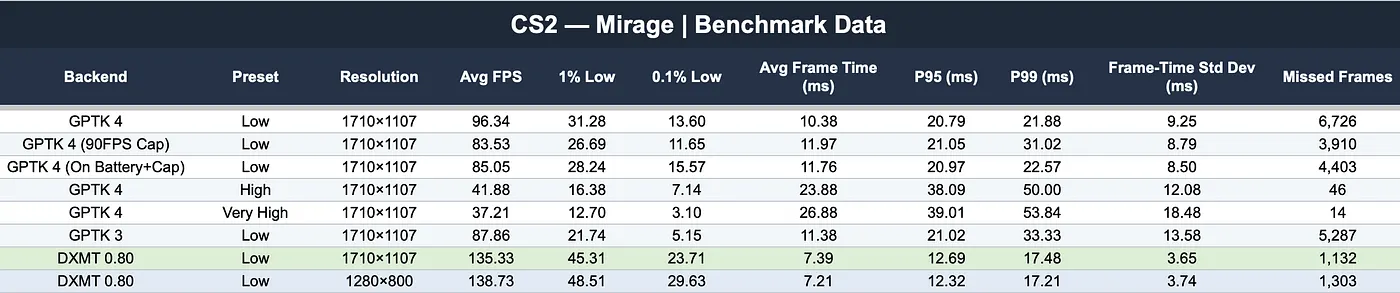
DXMT 0.80 »> GPTK4 for CS2. On low settings:
- FPS: +40.5%
- 1% low: +44.8%
- 0.1% low: +74.3%
- Average Frame Time: -29%
- P95: -39%
- P99: -20%
- Frame Time Standard Deviation: -60%
DXMT 0.80 produces both higher throughput and substantially more consistent frame delivery.
GPTK4 > GPTK 3
- FPS ~ +10%
- Higher 1% low and 0.1% low
GPTK 4 clearly improves the experience over GPTK 3.
Lower Resolution Barely Increases DXMT 0.80 FPS Lowering the resolution from 1710×1107 → 1280×800 produced only a 2.5% increase in average FPS for a pixel count reduction of ~46%, suggesting that the workload is not strongly GPU-resolution-bound under these settings.
Running On Battery Doesn’t Drop The Performance
Online Matchmaking Deathmatch
 With a 90 FPS cap, DXMT 0.80 maintains ~88–89 FPS across all four tested maps, while keeping frame times around 11.3 ms. However, frame-time consistency varies significantly between maps, particularly at the 0.1% low.
Metal HUD’s displayed FPS vs our calculated FPS
The FPS values reported in this article are calculated from the frame-interval data recorded by Metal HUD rather than copied from the FPS summary displayed in the exported HTML. So, the values will differ from the FPS shown by Metal HUD itself. Using the frame-interval data provides a consistent calculation across all benchmark runs.
FPS = number of rendered frames / measurement duration
Possible Reasons why DXMT works better than GPTK
- CS2 primarily uses Direct3D 11 on Windows. DXMT is specifically designed for translating Direct3D 10/11 workloads to Apple’s Metal API, while D3DMetal is a broader compatibility layer designed to support both older Direct3D APIs and Direct3D 12 workloads.
- This does not mean DXMT is inherently faster than D3DMetal for every game. The results suggest that for this particular D3D11 workload, DXMT’s implementation is currently more efficient on this hardware/software configuration.
6. Conclusion
On the M5 MacBook Air tested here, DXMT 0.80 provided the best CS2 performance among the translation layers tested. Compared with GPTK4, it delivered substantially higher average FPS while also improving 1% and 0.1% lows and reducing high-percentile frame times.
The results also suggest that CS2 is not strongly GPU-resolution-bound in this configuration, as reducing the resolution produced only a small increase in performance. GPTK4 nevertheless represents an improvement over GPTK3, indicating that D3DMetal’s newer implementation provides measurable gains for CS2. DXMT 0.80 wasn’t merely producing higher average FPS — its frame-time behaviour is also better.
- Five-minute runs provide a sustained-performance snapshot but do not represent every possible gameplay scenario.
- Online matchmaking introduces variability from player behaviour and network conditions.
- These results are solely for CS2 and not to be generalised for all other games.